
A baggage tale
“Give me your passport, please. Where are you flying to?”
“We are flying back home. To South Africa.”
It is 8pm. The tired young man glares over our documents and points with distaste at our luggage. “Too heavy.” Without even weighing it. Without knowing the full context.
Because we are not merely flying home. I am relocating – carrying with me a whole life that existed for three years in another country. What he is seeing is not just five suitcases, two cabin bags, two laptop bags, and a 1977 Morris guitar. What he is seeing is an entire life packed into a combination of pieces measuring 81 x 51 x 30 centimetres.
The moment he measured my luggage as too heavy, he measured my whole life as too heavy. And something irreconcilable snapped.
Our eyes locked. And what transpired next was not my finest moment.
Living in Vietnam for three years taught me that the Western concept of “the customer is always right” simply doesn’t exist here. What exists is equality, and a mild gentleness that doesn’t allow for aggressive customers to express their dissatisfaction with a raised voice. Let’s be honest – Vietnamese people are loud! But they are not rude. You settle any disagreement with softness, not elevated emotions and a high-pitched voice.
From the moment my life was measured – with the blink of an eye – as too heavy, something inside me was triggered. What started as pleading – hopeful, desperate begging – to be forgiven a few kilograms, escalated into a nightmarish horror movie, culminating in the death of a green speckled teapot.
We started weighing the hand luggage. What should have been 24 kilograms between my son and me came in at 32. Then the suitcases – all five of them, each at least 2 kilograms overweight. And then there was the situation with the guitar…
“Please, sir. I lived here for three years. Can you help us? I don’t want my last memory of this country to be this mess.”
“No. This is too heavy. You can’t fly like that. You need to pay extra for everything.”
By that stage, my son tried to intervene – attempting to mediate between a furious mother and an increasingly firm airport ground staff member. Blinded by rage and overwhelmed by the feeling that my heavy life was a burden to everyone around me, I loaded everything back onto the trolley and stampeded to the exit to unpack right there in the airport.
The colourful Vietnamese lanterns, bought in the Old Quarter, were the first to go. When my son dodged a lilac lantern flying past his head, he quietly stepped outside the building.
My most precious cups and saucers, and the green speckled teapot from Bát Tràng pottery village just outside Hà Nội, had been carefully packed in tin boxes from various farm stalls, wrapped in beautiful silk scarves. I gave those boxes one look and knew: these beloved belongings were the only thing standing between us getting on the plane or living in Noi Bai Airport like Tom Hanks in The Terminal. Each box weighed around 2.5 to 3 kilograms. It was quicker to let them go than to decide which pants or t-shirts belonged in the bin instead.
I know the cliché – earthly belongings mean nothing, because we leave everything behind when we cross the river Styx. But abandoning these things on the floor of Noi Bai Airport was painful. The weight wasn’t lifted from my heart.
Then came the guitar. My son had quietly decided to send his 1977 Morris guitar to a friend in Tây Hồ. He felt there was no time to negotiate paying extra, and his mother was not in a mental state to do so either.
By the time we stood in the immigration queue, my heart was pounding. My son looked at me and shook his head.
“Mom. Please promise me we will never travel like this again.”
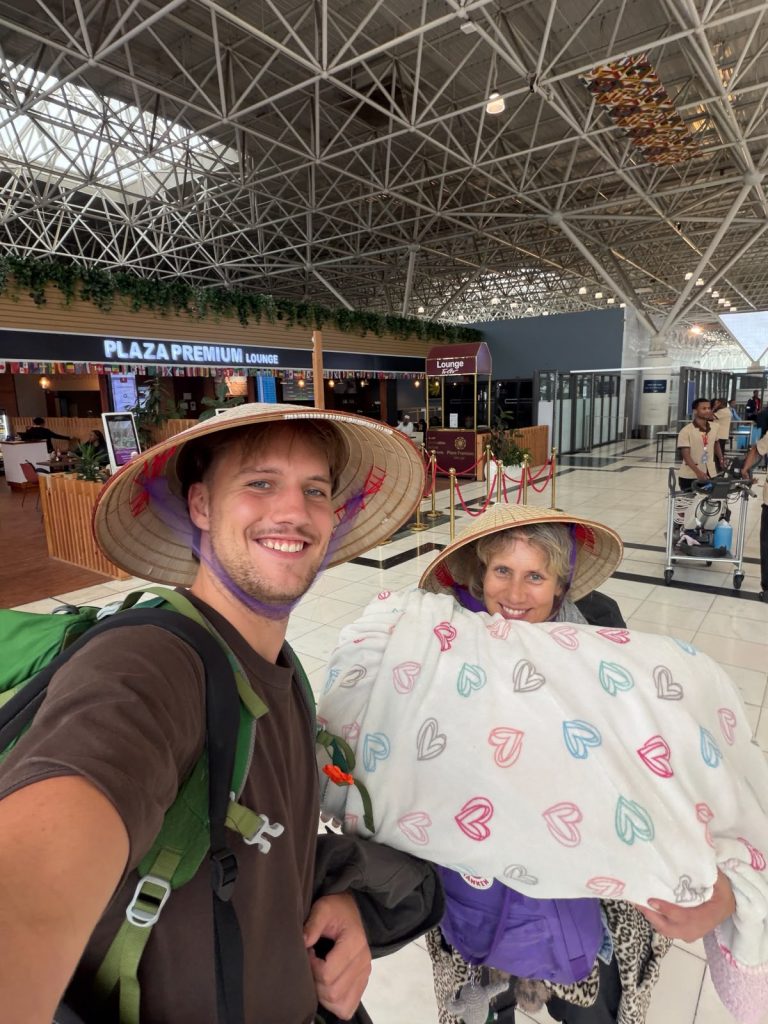
Carl and I. Bole International Airport, Addis Ababa. Don’t ask.
Standing there with our iconic Vietnamese conical hats, my pillow stuffed with three stainless steel Starbucks tumblers – gifts from Concordia students – my late mother’s woollen blanket draped over my arm, and my bra discreetly housing two 200g packets of Vietnamese coffee, we had 26 kilograms of hand luggage. Still 2 kilograms over.
And standing there, I had to admit something uncomfortable: my anger at that young ground staff member was, perhaps, my own projection. Because why do I carry such a heavy load? Why can’t I let go and live a simpler, less complicated life? Why do I carry the weight of things present and past?
I’m no Scrooge, but some ghosts still follow me – and their bones are the heavyweights preventing me from making leaps forward. Carl was right when he urged me to start packing earlier. But I procrastinated. I spent my last days in Hanoi playing a game of shifting weight – fitting things into bags that were never meant to make the journey, moving 2 kilograms here into 4 kilograms there, choosing to shift rather than let go.
I’ve always found moving house, changing offices, changing schools to be a daunting and challenging task. I struggle to let go. I struggle to say goodbye.
The Science of Heavy
I am mindful that what I’m currently experiencing is not just emotional – it is measurable. The Holmes and Rahe Social Readjustment Rating Scale, developed by psychiatrists Thomas Holmes and Richard Rahe in the 1960s, ranks life events according to their stress load, on a scale from 10 to 100. Death of a spouse sits at the top, rated 100. A minor traffic fine sits at the bottom, rated 11. Somewhere in between lie the events most of us navigate quietly, often without recognising their cumulative weight.
My score over the past few months looks like this:
Change in residence (20) + major change in working hours or conditions (20) + major change in living conditions (25) + major change in responsibilities at work (29) + changing to a different line of work (36) + major change in financial state (38) + major business readjustment (39).
Total: 207. Holmes and Rahe concluded that a score between 150 and 300 carries a 50% chance of a major health breakdown within the next two years – if you don’t actively look after yourself.
This is precisely why I tried to transition intentionally, following the RAFT model I wrote about last week. But nothing could fully prepare me for the chaos of the final days. My son wrote his second-year university exams online from our apartment while I had to vacate for hours at a time. And I rediscovered, in spectacular fashion, that I am the reigning queen of procrastination.
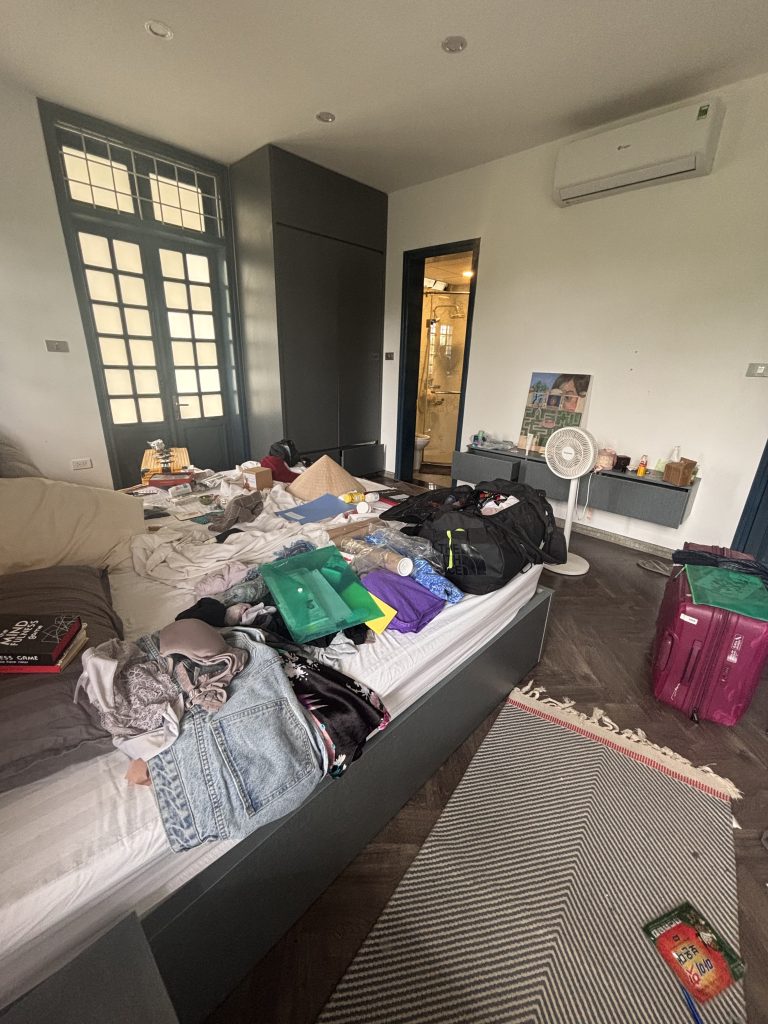
One hour before leaving for the aiport. My bedroom in Tay Ho. True story.
The Anticlimax
Now, back in my home country for only a few hours, I feel hungover. A little flat. A little hollow. I could have done things differently. I could have started packing and sorting earlier. I could have remembered to move those two packets of coffee from my bra back into the hand luggage before we hit the security check. I could have done a lot of things differently.
But for now, I am trying to be gentle with myself. And with my family, who have witnessed a handful of life-changing experiences alongside me.
I have started to find my voice again – I might have begun to speak Cecilia. But part of learning any new language is discovering that you are not always fluent. Certain vocabulary still needs to be learned. Certain weight still needs to be set down.
We all carry weight – not just in our suitcases, but in our habits, our histories, our hesitations. Some of it is precious. Some of it is just old socks and books we haven’t touched in years.
What are you carrying right now that you haven’t yet decided to put down?
Enjoyed this? Subscribe to get new Insights from Dr Cecilia.
Lets talk